When you compare coaches, you will see three sets of letters after their names. This guide explains ACC vs PCC vs MCC: what each International Coaching Federation (ICF) credential requires, what the difference means for you as a client, and how to check that a coach really holds one.
ACC vs PCC vs MCC: the short answer
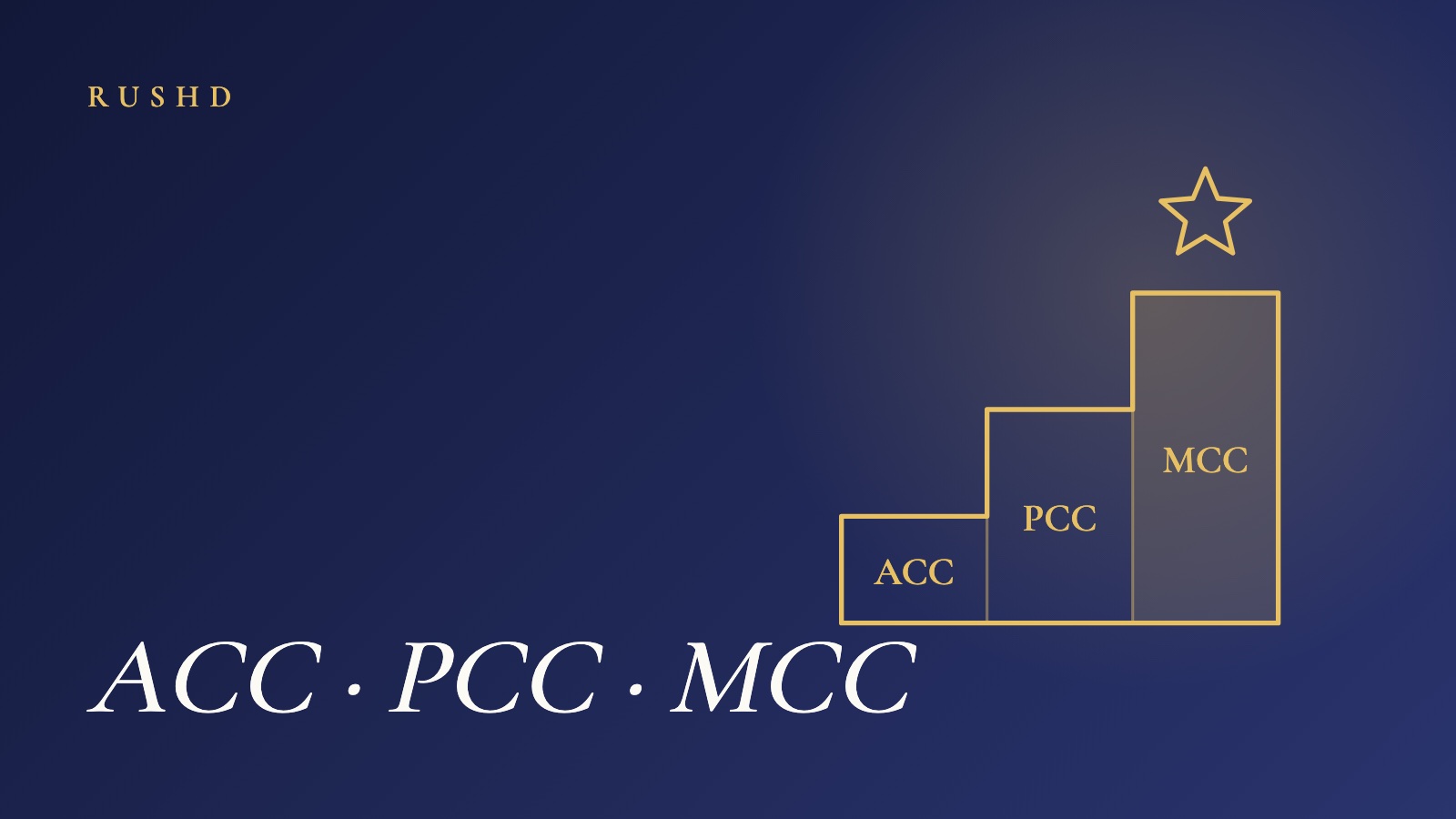
The ACC (Associate Certified Coach), PCC (Professional Certified Coach) and MCC (Master Certified Coach) are the three levels of ICF credential, and each requires more coach training and more logged coaching hours than the one before: from 60+ hours of training and 100+ hours of coaching for the ACC to 200+ and 2,500+ for the MCC. All three also require an assessed recording of real coaching and an exam, so even the first level is a real standard.
What each credential requires (hours, training)
The figures below come from ICF’s own pages: its credential comparison, its experience requirements and its education requirements, as checked in November 2026. ICF revises its rules from time to time, so its site has the final word.
ICF credential requirements
ACC
Associate Certified Coach
Education
60+ hours
Coaching
100+ hours, 75 paid
Clients
8 minimum
Recordings assessed
1
Exam
ACC Exam
Prerequisite
None
PCC
Professional Certified Coach
Education
125+ hours
Coaching
500+ hours, 450 paid
Clients
25 minimum
Recordings assessed
2
Exam
ICF PCC-MCC Exam
Prerequisite
None
MCC
Master Certified Coach
Education
200+ hours
Coaching
2,500+ hours, 2,250 paid
Clients
35 minimum
Recordings assessed
2
Exam
ICF PCC-MCC Exam
Prerequisite
Holds or has held a PCC
All three levels
10 hours of mentor coaching. Renewal every 3 years with 40+ continuing education credits; for the ACC, these include 10 hours of mentor coaching.
Some details sit behind the headline numbers. Coaching hours count only once a coach has begun their coach training. For the ACC, 25 of the 100 hours must fall within the 18 months before the application, and for the PCC, 50 of the 500.
ICF also accredits training programmes at three levels. A Level 1 programme gives 60–124 hours of coach-specific education, Level 2 gives 125–175 hours, and Level 3 gives 75+ hours of advanced study. Finishing a programme is not the same as holding a credential, which comes only after the experience, recordings and exam.
What the difference means for a client
Think of the levels as a record of training and practice, not a ranking of who will suit you. Here is what each tells you, with examples from Rushd’s roster. At the time of writing, Rushd has 12 PCC coaches and 2 ACC coaches.
Rushd’s roster at the time of writing
12
PCC coaches
2
ACC coaches
0
MCC coaches
Three PCC coaches say on their profiles that they are on the path to MCC.
ACC: trained, assessed and practising
ICF’s credentials overview calls the ACC “the foundation for new coaches”. An ACC has at least 60 hours of training and 100 hours with real clients, and has passed an assessed recording and an exam. An ACC may also bring a long career from before coaching. Faten Choufani (Beirut), for example, describes “over 13 years of corporate experience, including leadership roles in the pharmaceutical industry” on her profile. Maram Bilbiesi (Riyadh) is an ACC who also lists executive, organisational development and change management coach certifications.
PCC: five times the coaching hours
A PCC has at least 500 hours of coaching with 25 or more clients and at least 125 hours of training. That is a lot of practice across many different clients. Most of Rushd’s coaches hold the PCC, including Dr Rola Sharif and Nayyer Abdul Rab in Riyadh, Reem Alkhudhairy in Dhahran and Rania Hammoud in Sharjah.
MCC: the highest level
ICF describes the MCC as “the highest level of coaching mastery, reserved for seasoned coaches”. It needs 2,500+ hours with at least 35 clients. Rushd has no MCC on its roster at the time of writing, but several coaches are on that path, according to their profiles. Gitanjali Sharma lists “MCC under review”, Shabeen Mazher says she is on the MCC pathway, and Umair Akram says he is working toward his MCC.
What a credential does not tell you
The letters say nothing about sector, seniority, language or whether you will trust this person. A PCC who has never worked with senior leaders may suit a CFO less well than an ACC who spent a decade in finance. Use the credential as a floor, then judge fit in a conversation. It does not set price either: our guide to executive coaching costs shows that ACC and PCC prices overlap.
How to verify a coach’s credential
ICF’s own lookup page puts it bluntly: “Anyone can call themselves a coach.” Checking is quick:
- Open ICF’s Verify a Coach directory and enter the coach’s name. It shows ICF membership status and credential status.
- If the name doesn’t come up, try other spellings. Arabic and Urdu names are often written several ways in English, and the page lets you use a percent sign (%) as a wildcard.
- Don’t rely only on the Credentialed Coach Finder. In ICF’s words, it “lists ICF credential-holders who are also members of ICF”, so a credentialed coach who is not a member won’t appear there.
- Read certificates carefully. “Certified executive coach” from a training school is a course certificate, not an ICF credential. Only the ACC, PCC and MCC are ICF credentials.
On Rushd, every coach holds an ICF credential. Rushd admits ACC, PCC and MCC coaches only, after a review of their practice and results and a conversation with Rushd’s coaching lead. You can read more in our standard.
Which level do you need?
For most people, the honest answer is: a credentialed coach whose experience matches your situation. A few rough guides:
Your situation
A clear, contained goal
such as preparing for a promotion or your first months as a manager
What to look for
An ACC or PCC with relevant experience will do the job well.
A senior role with complex stakeholders
such as a new executive post or a board relationship
A PCC who works with leaders at your level. Ask about it in the chemistry session.
You are a coach working toward a credential
Mentor coaching from a qualified mentor. Shabeen Mazher’s profile, for example, says she is an ICF mentor coach for ACC and PCC.
Every Rushd coach offers a free 30-minute chemistry session, so you can talk to coaches at different levels before you decide. If you would rather start from your goal, try Find my match.
Frequently asked questions
Is a PCC better than an ACC?
A PCC has more training and at least five times the logged coaching hours, so they have more practice behind them. That does not make them the better choice for every client. Fit with your goal, sector and level matters as much, so meet the coach before deciding.
Do ICF credentials expire?
Yes. All three are renewed every three years with at least 40 credits of continuing coach education, and ACC renewal includes 10 hours of mentor coaching. ICF also allows a 60-day grace period, during which a credential stays active after its expiry date.
Is an ICF-accredited course the same as an ICF credential?
No. An accredited course is training. The credential comes later, once the coach has logged the required client hours, completed mentor coaching, passed an assessed recording and passed the exam. A coach can finish an accredited programme and still not hold a credential.
Are there MCC coaches on Rushd?
Not at the time of writing. Rushd’s roster has 12 PCC and 2 ACC coaches, and three of the PCC coaches say on their profiles that they are on the path to MCC. Each coach’s credential is shown on their profile in the coach directory.
What does Rushd check besides the credential?
The credential is the entry ticket, not the whole check. Rushd also reviews each coach’s practice and results, and each coach has a conversation with Rushd’s coaching lead before joining. Our standard sets this out.