
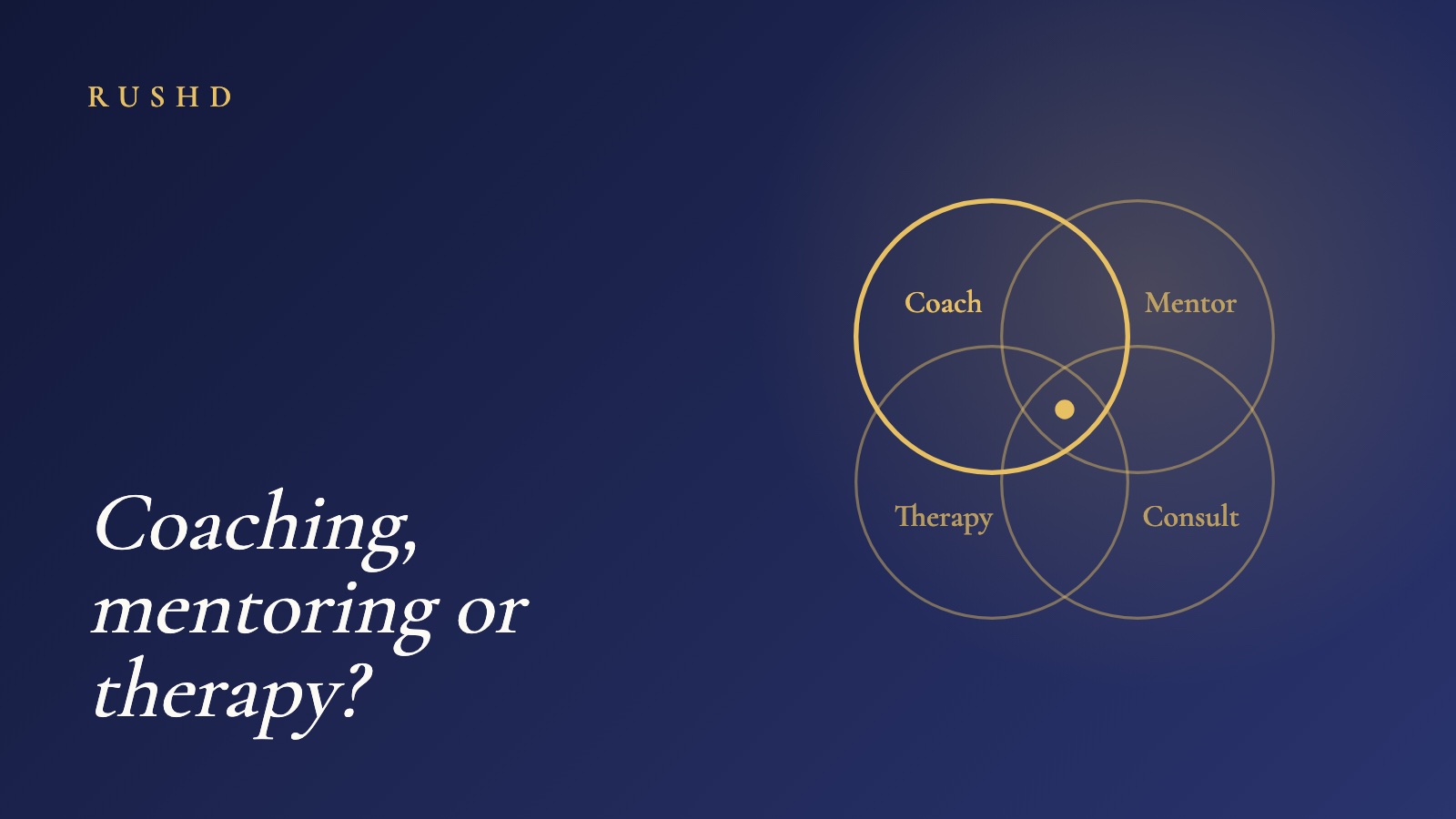
When you start looking for help at work, the first question is usually coaching vs mentoring, and then where therapy and consulting fit in. All four are conversations with someone outside your own head, but they do different jobs. This guide sets out what each is for, so you pick the right kind of help the first time.
One-line definition of each
- Coaching: the International Coaching Federation (ICF) defines coaching as “partnering with clients in a thought-provoking and creative process that inspires them to maximize their personal and professional potential”. In plain terms, a coach helps you think through and act on your own goals, and the answers stay yours.
- Mentoring: someone further along your path shares what they have learned. ICF’s guide to working with a coach puts it neatly: “Mentoring is like having a seasoned guide on a well-worn path.”
- Therapy: a licensed mental health professional helps you with emotional difficulties and mental health. In the same ICF guide’s words, “Therapy is the space to heal, recover from past traumas, emotional pain, or dysfunctional patterns.”
- Consulting: an expert studies a problem, tells you what to do about it, and often does some of the work.
Coaching vs mentoring vs therapy vs consulting: side by side
Coaching
“How do I get there?”
Who holds the answers
You. The coach asks questions and challenges your thinking.
Focus
Your goals, now and next
Who provides it
A trained coach, ideally ICF-credentialed
Usual shape
A set programme of sessions with a clear goal
Good for
Leadership, career decisions, changing how you work
Mentoring
“What did you do?”
Who holds the answers
Mostly the mentor, from experience.
Focus
The mentor’s path, advice and contacts
Who provides it
A more experienced person in your field
Usual shape
Often informal and open-ended
Good for
Learning the ropes in a field or company
Therapy
“Why do I feel this way, and how do I recover?”
Who holds the answers
Shared, guided by the clinician’s training.
Focus
Mental health, emotions, past and present
Who provides it
A licensed psychologist, psychiatrist, counsellor or therapist
Usual shape
Set by the clinician
Good for
Anxiety, low mood, trauma, grief, health symptoms
Consulting
“What should we do?”
Who holds the answers
The consultant.
Focus
A business or technical problem
Who provides it
A subject expert or firm
Usual shape
A project with deliverables
Good for
Strategy, systems, specialist know-how
The simplest test is who does the thinking. A mentor and a consultant bring answers. A coach, as ICF’s guide says, “doesn’t give you the answers; they ask you the questions to help you find the solutions for yourself.” A therapist works on your health and wellbeing, which a coach is not trained or licensed to treat.
When coaching is the right choice
Coaching fits when you are broadly well, you have a goal or a decision in front of you, and the answer depends on you rather than on knowledge you lack. It works best when you want to think, not be told.
A hypothetical example. Say you are a finance manager in Jeddah, newly promoted to lead the team you used to sit in. You know the work. What you don’t know is how to give feedback to a former peer or how to stop doing their work for them. Nobody can hand you a script for your team, so a coach is a good fit: someone to help you work out your own approach and hold you to it. Our guide for first-time managers goes further.
Other signs coaching suits you
You are stepping into a bigger role and want to think through what it asks of you.
You are weighing a career move and keep going round in circles.
You want to change a habit at work, such as how you delegate or handle conflict.
You want a confidential space to think out loud, away from colleagues.
When it is not, and what to choose instead
When you need know-how you don’t have, choose a mentor, a trainer or a consultant. Say you run a family business in Dubai and need a pricing model for a new market. That is a question of expertise. A coach can help you decide and lead the change, but a consultant or an experienced mentor will get you to the answer faster.
When the problem is your health, start with a doctor or a licensed mental health professional. Say that for months you have felt flat and exhausted, you sleep badly and you dread Sunday evenings. That may look like a work problem, but symptoms like these need a health professional first. Coaching is not therapy or medical care, and a coach cannot diagnose or treat anything. Our page on burnout covers where coaching can and can’t help.
If you are in crisis or thinking about harming yourself, contact your local emergency services straight away.
ICF’s guide sums up the line between the two: “Therapy often focuses on ‘why,’ coaching focuses on ‘how.’” If you raise something in a first conversation that belongs with a clinician, expect a good coach to say so.
Can you combine them?
Yes, and many people do. The trick is to be clear which conversation is for what.
Coaching+Mentoring
A mentor inside your organisation can explain how decisions really get made. A coach outside it helps you decide what you will do with that knowledge.
Coaching+Consulting
A consultant designs the restructure; a coach helps the leader who has to carry it out.
Coaching+Therapy
Possible, but therapy comes first if your health is affected. Keep the two separate, tell each professional about the other, and follow your clinician’s advice on timing.
Some coaches also mentor. On Rushd, Gitanjali Sharma lists leadership coaching and mentoring among the areas she works in, and Rania Hammoud is described on her profile as a leadership coach and mentor. If you want both, say so in the chemistry session and agree when you are getting advice and when you are being coached.
Every Rushd coach is ICF-credentialed and offers a free 30-minute chemistry session, so you can test whether coaching is right for you before you commit. To see who fits your goal, start with Find my match.
Frequently asked questions
What is the main difference between coaching and mentoring?
A mentor shares their own experience and advice. A coach asks questions that help you find your own answers, whether or not they have done your job. If you need to learn how things are done, find a mentor; if you need to decide what you will do, find a coach.
Is a coach the same as a therapist?
No. A therapist is a licensed professional trained to assess and treat mental health conditions. A coach works with people who are broadly well on goals and decisions. If you have symptoms such as persistent low mood, anxiety or exhaustion, see a doctor or a licensed mental health professional.
Does a coach need a qualification?
Anyone can use the title, as ICF’s own lookup page warns: “Anyone can call themselves a coach.” An ICF credential (ACC, PCC or MCC) shows assessed training and logged coaching hours. Our guide to ACC vs PCC vs MCC explains the levels, and Rushd admits credentialed coaches only, as set out in our standard.
Can my manager be my coach?
A manager can use coaching skills, such as asking good questions instead of giving answers, and that helps. But your manager also judges your performance, so some things are hard to say to them. An external coach has no stake in your appraisal, which makes it easier to be candid.
Is coaching confidential?
ICF’s guide describes coaching as “a confidential partnership to help you grow”. If your employer pays, agree at the start what they will hear, such as attendance or agreed goals, and what stays between you and the coach.